Somewhere in the last few years, the questions around sustainability have changed. It used to be all about budget, footprint and deadlines. Now there is usually a line on a form about sustainability. Maybe procurement added it, maybe it “came down from above” but either way, the questions need to be answered properly. And here’s the trouble, most sustainability talk in our industry is just wallpaper. Warm words, green tinted, impossible to do anything with. It all sounds lovely but tells you nothing.
It isn’t a bolt-on.
Taking that into account, we’d rather show you how we actually work.
For all our Exhibitionologists, sustainability isn’t a service with its own price tag. It isn’t something we add on when a brief asks for it. It’s just how the place runs, and it has been for a long time. Some of it is big and deliberate and some of it is stickers on the bins…
The greenest stand is often one that already exists
Start with the biggest thing, because it also happens to be the one that saves you money.
The greenest stand is usually the one you don't build from scratch.
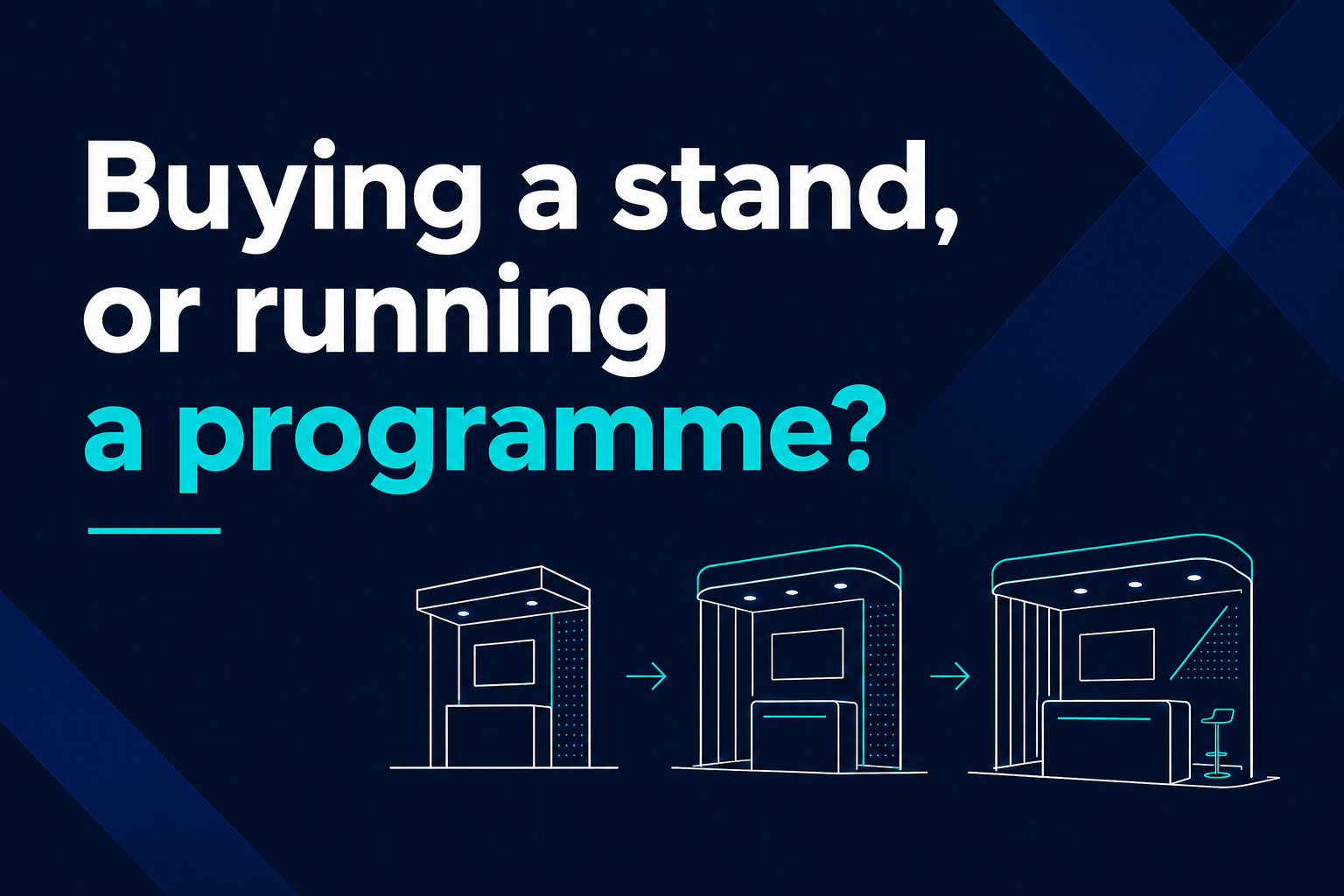
A lot of what turns up on a show floor never needed to be new. A structure from last year, reconfigured. Display units that come back out in a different shape. Graphics refreshed with a panel swap instead of a full reprint. None of it costs the earth, in either sense, and most of it costs you less than starting again.
Reused doesn't mean second best. A structure that comes back out is stripped, refinished and checked over until you'd never know it had a life before yours. It still has to look faultless when the doors open, so it does.
That isn't us being frugal on your behalf. It's the honest answer to a question a lot of suppliers would rather you didn't ask: does this actually need building, or does something already exist that meets our high standards?
Your stand shouldn't retire after three days
We'll take that further than our own warehouse, too.
When we build something bespoke for you, we'll often nudge you to think about where it lives afterwards. A feature wall that becomes signage in your reception. A counter that ends up in a marketing suite. Plinths that move off the show floor and into an office. It's your investment. There's no good reason it should work for three days and then gather dust.
Selling you a second one would be easier. This is better.
You can't reuse what you can't find
None of that works if you don't know what you've got.
So we went and catalogued it. All of it. Every piece of furniture, every structure, every accessory in the warehouse, logged and accounted for, so that when a brief lands we can see at a glance what already exists that might fit yours. It isn't glamorous work. It's a stocktake. But it's the difference between reuse as a nice idea and reuse as something we can put on the table on day one. It means when we tell you we can reuse something, we're not hoping. We're reading off a list.
Last year at least 64% of our projects reused elements from a client's own previous stand. And that's just the part you'd spot. Look wider, at hire walling, furniture, platforms, the AV and tech, and every stand we build has reuse in it somewhere.
And it's in the small things too
It shows up in the quieter stuff, as well.
We reuse the blankets and boxes we ship in rather than buying new every time. The warehouse has skylights and the office has big windows, so we work in the daylight and keep the lights off when we can. There are stickers on the bins so separating the recycling is a daily habit rather than an afterthought.
None of that is going to save a rainforest on its own, and we won't pretend otherwise. But it's the sort of thing you only bother with if you actually mean it. It adds up quietly across thirty years of shows.
What to ask a supplier who says they're green
If you're weighing up suppliers on this, here's what sorts the real from the worthy. Ask them:
● Can you tell me what you'd reuse for this build, specifically?
● Is this designed to be reconfigured, or is it single use dressed up?
● Where does it live between shows, and who pays to store it?
● What happens to it once we're done with it?
A supplier who means it will have the answers ready. A supplier who's been saying “sustainable” because it looks good on a deck will start reaching. You'll know inside a minute.
Thirty years of it
We've been designing and building stands for thirty years. Long enough to have thrown away more than we'd like in the early days, and long enough to have learned better. Building things that last, come back out, and earn their keep more than once is simply how we do it now. Not because it's fashionable. Because it's right, and because it's usually the smarter buy for you as well.
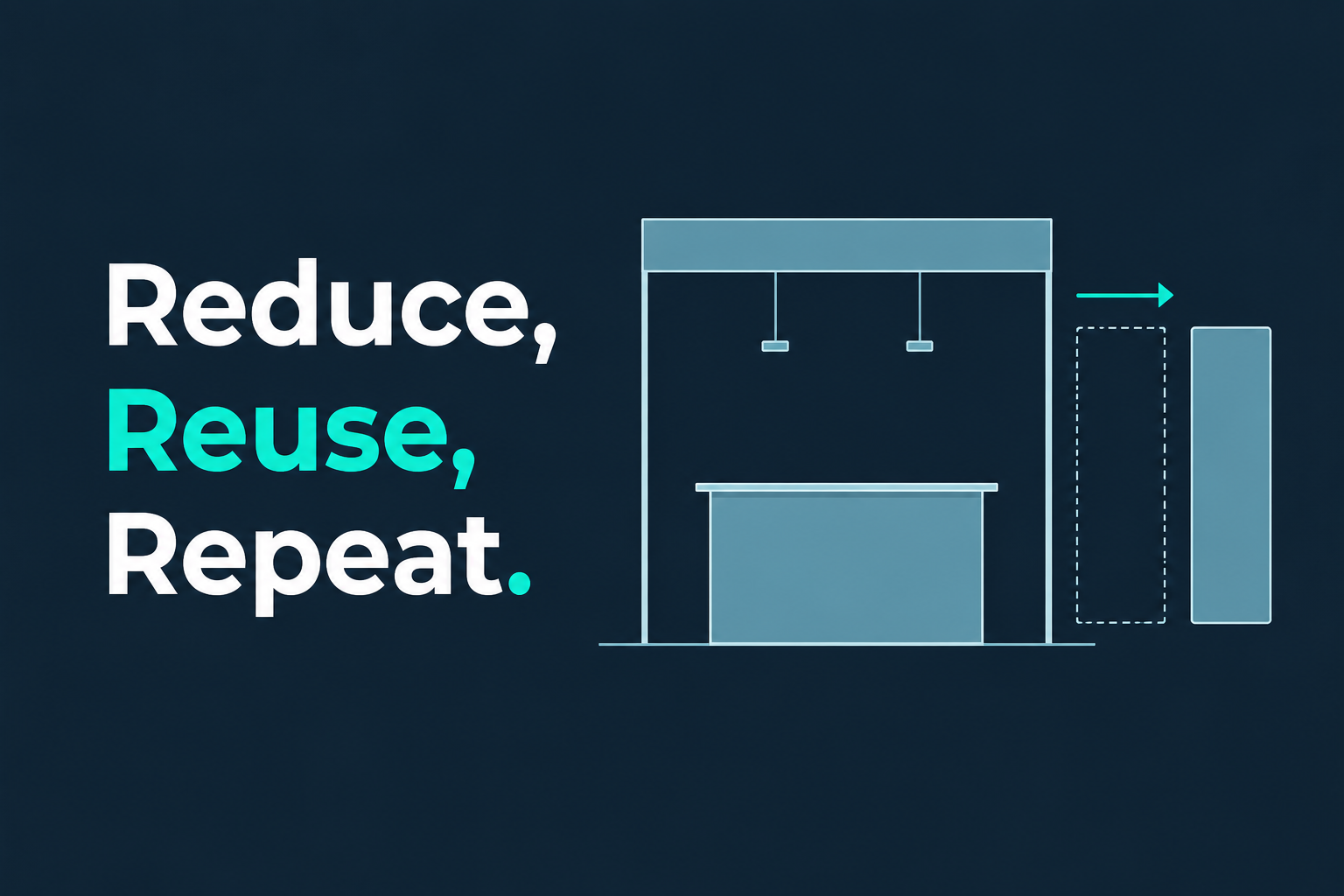
Reduce, reuse, repeat. It isn't a slogan. It's the job.
Planning a run of shows and want a supplier who'll tell you honestly what needs building and what doesn't? Drop us a line. No hard sell, just a straight answer.
You can also see how this works across real builds on our Work page, or get in touch if you've a brief you'd like to talk through.
Common questions
Are exhibition stands reusable?
A well built stand is, if it's designed to be. Modular and bespoke stands alike can be reconfigured, refreshed and redeployed across several shows. The trick is planning for reuse from the start, and knowing exactly what you already own.
What makes an exhibition stand sustainable?
Less than the marketing suggests, and more than you'd think. The single biggest factor is reuse: not building new when something existing will do. After that it's honest material choices, cutting waste, sensible energy use, and giving the stand a life beyond the show.
Is a reusable stand cheaper than building new each time?
Usually, across a run of shows. You spread the cost of the structure over several outings instead of paying for a fresh build every time. Storage and reconfiguration carry costs of their own, so ask for it itemised across the year and compare properly.
What is ESSA, and does membership mean anything?
ESSA is the Event Supplier and Services Association, the trade body for our industry. Membership means a supplier signs up to shared standards on quality, safety and sustainability. We're members, and this year we're going further: we've started tracking our energy, travel and waste, on the simple logic that you can't improve what you haven't measured. Reuse and cutting waste have been a habit here for years. Now we're putting numbers to it.
How do you cut waste across a run of shows?
By reusing structures and furniture rather than rebuilding, refreshing graphics with panel swaps instead of full reprints, storing stands properly between shows, and cataloguing what we own so nothing gets forgotten and needlessly built twice.
Want to know more about how we build great stands for great brands? Sign up to our Newsletter, or if you're looking to make sure you've thought of everything for your build, why not download our The Ultimate Exhibition Success Kit.